Household Routine: How to Divide Chores and Never Pile Up Mess Again
A fair, visible system to divide house chores among adults and kids, with a weekly chart, age-appropriate tasks and the rules that prevent pileup.
In many homes, the mess doesn't come from lack of cleaning, it comes from lack of a system. One overloaded person, the others "helping" when they remember, and the invisible agreement that someone will always handle it. The fix isn't nagging more: it's building a structure where every task has an owner, a day and a standard. What's written doesn't need remembering, and what doesn't need remembering doesn't cause fights.
Step 1: Make the invisible work visible
Sit down with everyone and list everything the house demands: the obvious (dishes, trash, laundry) and the invisible (noticing the soap ran out, scheduling repairs, planning groceries, paying bills). The job of remembering is work too, and it usually piles on one person. The full list surprises and, by itself, rebalances the conversation.
Step 2: Sort by frequency
- Daily: dishes, beds, counters, returning stray items;
- Weekly: bathrooms, laundry, floors, sheets, groceries;
- Monthly: inside the fridge, windows, washing machinepantry review.
Step 3: Distribute with clear rules
- Every task has one owner. "Everyone handles it" means no one does.
- Preference before assignment: whoever hates dishes may love cooking; trade before imposing.
- An agreed standard: define together what "clean kitchen" means to avoid the classic "but I cleaned it" versus "this isn't clean".
- Rotate the unpopular ones: trash and bathroom rotate weekly or monthly, tracked on the chart.
Step 4: The visible chart
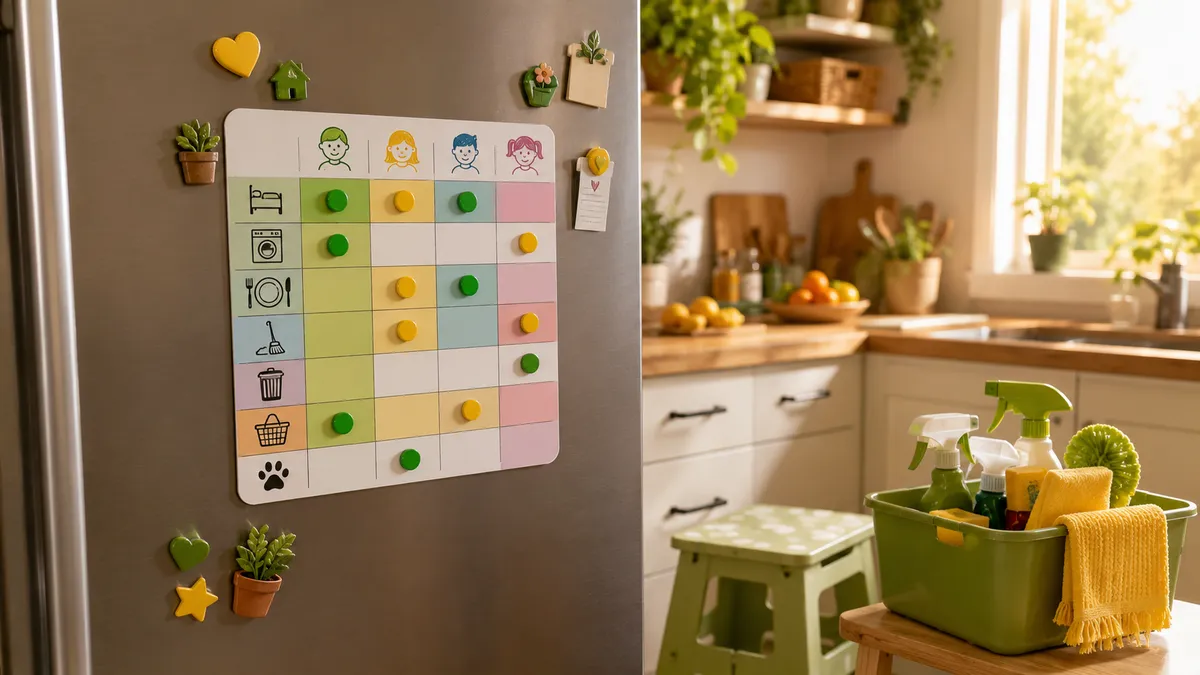
Paper on the fridge, a whiteboard or a shared app, format matters less than visibility. Columns: task, owner, day. Checking things off gives a sense of progress and kills the question that causes the most friction: "did you do it yet?". For kids, magnet or sticker versions turn the routine into a game.
Step 5: The two daily anchors
Systems fail at pileup. Two short routines prevent it:
- Evening reset (10 min): everyone returns what they used that day, cushions, dishes, toys, jackets;
- Morning check (5 min): bed made and breakfast dishes handled before leaving.
With the anchors running, weekly cleaning turns light, plug in the 30-minutes-a-day routine and the house starts running on autopilot, without overloading anyone.
Frequently asked questions
From what age can children help with chores?
Early on, with proportional tasks: around age 3 they put toys away with supervision; older kids make their bed, set the table and feed pets; teenagers own complete tasks like dishes and their own room. Adapt to each child's pace.
How do adults split chores fairly?
Start by listing everything the house demands, including the invisible work of remembering and planning. Divide by preference and availability, each task with a single owner, and review the split periodically in a quick talk.
What if someone doesn't do their part?
Talk outside the moment of irritation and check whether the task is well defined (what, when, expected standard). Many failures come from vague agreements. If it persists, redistribute: a good system is one that works with the real people in the house.